
THE ROAD BACK
Customized Restorative Discipline & Student Reentry Programs
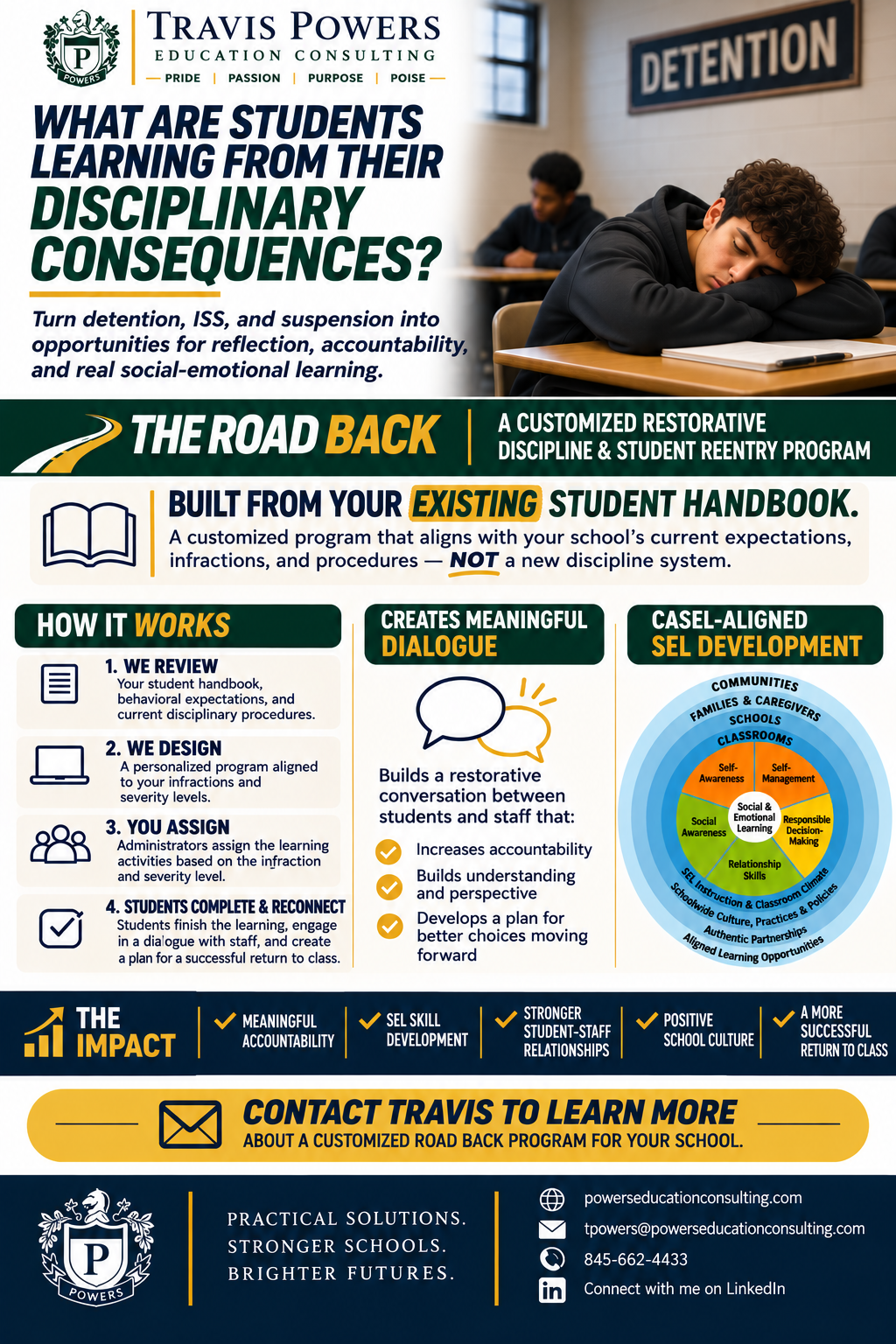
What Are Students Learning From Their Disciplinary Consequences?
Detention, in-school suspension (ISS), and out-of-school suspension are sometimes necessary parts of maintaining a safe and structured school environment. But what happens when students finish their classwork? Are we missing an opportunity for meaningful learning?
What if disciplinary consequences could become opportunities for reflection, accountability, and social-emotional growth?
That's the idea behind The Road Back, a customized restorative discipline program developed by Travis Powers Education Consulting for middle schools, high schools, and charter school networks.
Your School. Your Handbook. Your Expectations.
Every school has its own culture, behavioral expectations, and disciplinary procedures. That's why The Road Back is not a one-size-fits-all curriculum.
We don't replace your discipline system. We build upon what you already have.
We work directly with school and district leaders to review their existing student handbooks, codes of conduct, disciplinary procedures, and schoolwide expectations.
From there, we develop a personalized, CASEL-aligned restorative learning curriculum that complements those existing procedures.
The result is a ready-to-use educational resource that administrators can incorporate into detention, ISS, suspension, and student reentry.
From Consequences to Learning
The Road Back is built around three fundamental principles:
Reflection: Helping students examine their decisions, understand their emotions, and recognize how their actions may have affected others.
Accountability: Encouraging students to understand why behavioral expectations exist, take appropriate responsibility, and identify what they could have done differently.
Restoration & Reentry: Creating meaningful dialogue between students and staff while helping students develop strategies for better decision-making and a positive return to the classroom.
Our programs are aligned with CASEL's five core social-emotional learning competencies:
Self-Awareness
Self-Management
Social Awareness
Relationship Skills
Responsible Decision-Making
The goal isn't simply to give students another assignment. It's to help them learn something meaningful from the experience.
How Does The Road Back Work?
1. We Review Your Student Handbook
We examine your existing disciplinary infractions, severity levels, behavioral expectations, and schoolwide procedures.
2. We Build Your Personalized Program
We develop age-appropriate restorative learning activities and resources that align with your school's expectations and address the behaviors your administrators encounter.
3. We Deliver a Ready-to-Use Curriculum
Your school receives a customized collection of resources that administrators can incorporate into existing disciplinary interventions and student reentry procedures.
4. We Help Encourage Meaningful Dialogue
Student assignments create opportunities for reflection and constructive conversations between students and staff about behavior, accountability, and future decisions.
Optional family-engagement components can also be incorporated based on your school's needs.
Built for Busy School Leaders
As a former Assistant Principal, Athletic Director, and district/network-level administrator, I understand firsthand the demands placed on school leaders.
Many administrators would love to incorporate more meaningful restorative learning into their disciplinary procedures. The challenge is often finding the time to research resources, develop assignments, and organize everything into a consistent program.
That's where I come in.
I work with your leadership team to develop a customized curriculum around your school's existing expectations, taking the curriculum development work off your administrators' plates.
Your staff can focus on what matters most: supporting students, reinforcing expectations, and building a positive school culture.
The Story Behind The Road Back
Early in my career as a high school Assistant Principal, I often visited our ISS room and found students sleeping, staring at the walls, or simply waiting for the day to end after completing their classwork.
One day, I gave a student-athlete an article about toughness, character, and emotional control, along with several open-ended reflection questions.
When I received his responses, I was genuinely surprised by the effort and insight he had put into them. He recognized that he needed to better control his emotions and that getting loud or angry wasn't a sign of toughness.
That student had very few behavioral issues for the remainder of the year, and we continued connecting through books and conversations.
Throughout my career, I began incorporating similar activities into disciplinary interventions.
What I found most valuable wasn't necessarily the assignment itself. It was the dialogue it created between the student and me.
I wanted to develop a more comprehensive collection of these resources, but like many administrators, I simply didn't have the time.
That experience ultimately inspired The Road Back.
Why "The Road Back"?
Because discipline shouldn't just be about removing a student from the classroom. It should also be about helping them successfully return.
The Road Back represents the journey from a disciplinary incident toward reflection, accountability, stronger decision-making, and reconnection with the school community.
A disciplinary consequence may temporarily remove a student from the classroom, but the learning should help them find their way back.